Large galaxies and faint nebulae highlight this deep image of the M81 Group of galaxies. First and foremost in the wide-angle 12-hour exposure is the grand design spiral galaxy M81, the largest galaxy visible in the image. M81 is gravitationally interacting with M82 just below it, a big galaxy with an unusual halo of filamentary red-glowing gas. Around the image many other galaxies from the M81 Group of galaxies can be seen, as well as a lucky satellite glint streaking across the image left. Together with other galaxy congregates including our Local Group of galaxies and the Virgo Cluster of galaxies, the M81 Group is part of the expansive Virgo Supercluster of Galaxies. This whole galaxy menagerie is seen through the faint glow of an Integrated Flux Nebula, a little studied complex of diffuse gas and dust clouds in our Milky Way Galaxy.
Just some photos.Mostly astronomy pics but other as well.Movie photos etc.The Walkingdead Dead and etc!
Thursday, March 15, 2012
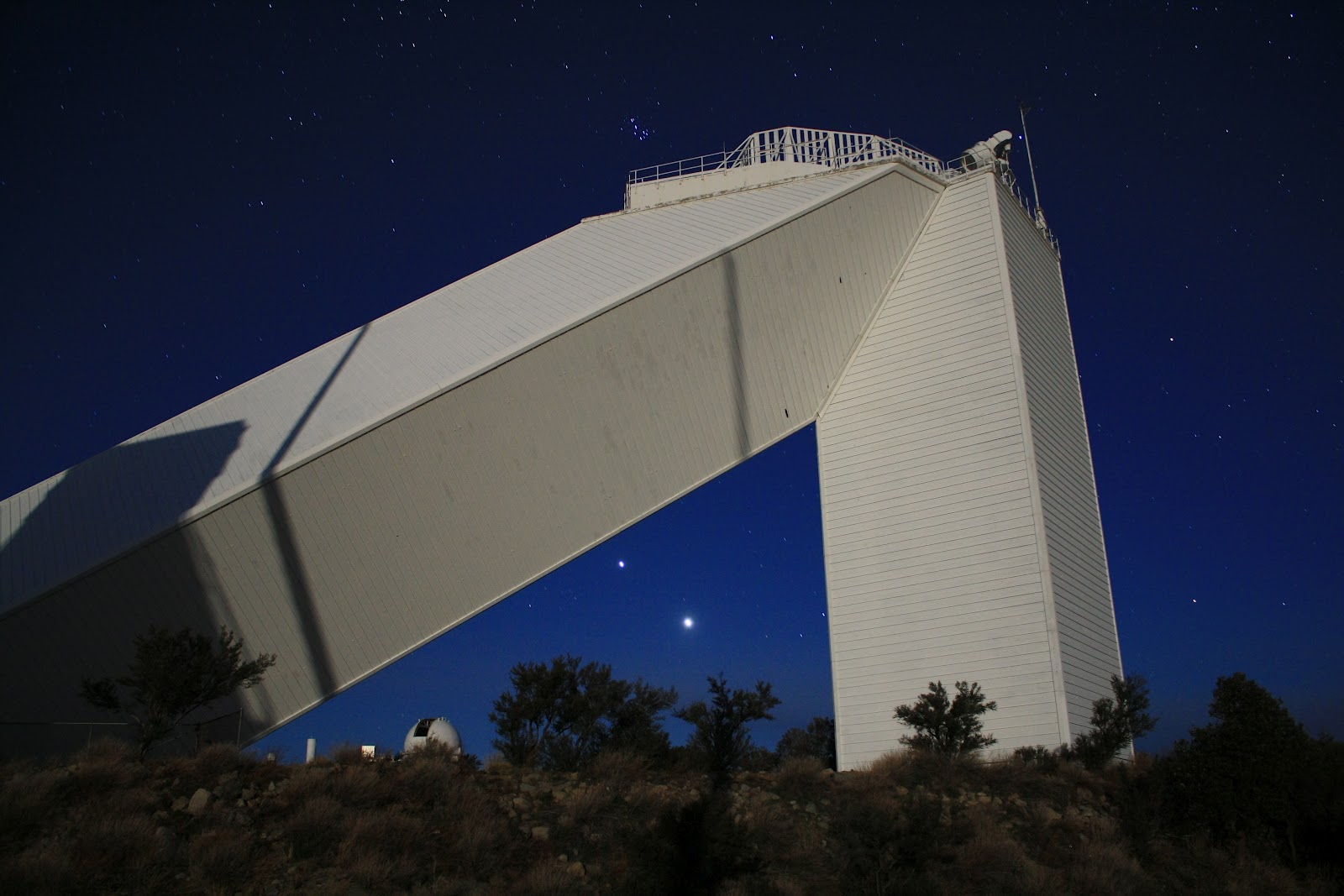
McMath-Pierce Solar Telescope
Bright planets Venus and Jupiter are framed by the National Solar Observatory's McMath-Pierce Solar Telescope in this very astronomical scene. The photo was taken at Kitt Peak National Observatory on March 9. A heliostat sits atop the 100 foot high solar telescope tower to focus the Sun's rays down a long diagonal shaft that reaches underground to the telescope's primary mirror. Of course, after sunset shadows were cast and the structure illuminated by light from the nearly full rising Moon. Opened to begin the night's work, the dome housing Kitt Peak's 2.1 meter reflector is included in the frame, while the Pleiades star cluster shines above the heliostat tower. The angular McMath-Pierce was commissioned 50 years ago to study the Sun, but has also made many observations of these two bright planets. On this night it was conducting observations of sodium ions in the tenuous lunar atmosphere.
Saturday, March 3, 2012
Its not Halloween let!! LOL
Spooky shapes seem to haunt this starry expanse, drifting through the night in the royal constellation Cepheus. Of course, the shapes are cosmic dust clouds faintly visible in dimly reflected starlight. Far from your own neigh...borhood on planet Earth, they lurk at the edge of the Cepheus Flare molecular cloud complex some 1,200 light-years away. Over 2 light-years across the ghostly nebula and relatively isolated Bok globule, also known as vdB 141 or Sh2-136, is near the center of the field. The core of the dark cloud on the right is collapsing and is likely a binary star system in the early stages of formation. Even so, if the spooky shapes could talk, they might well wish you a happy Halloween.
Friday, February 24, 2012
The Rosette Nebula
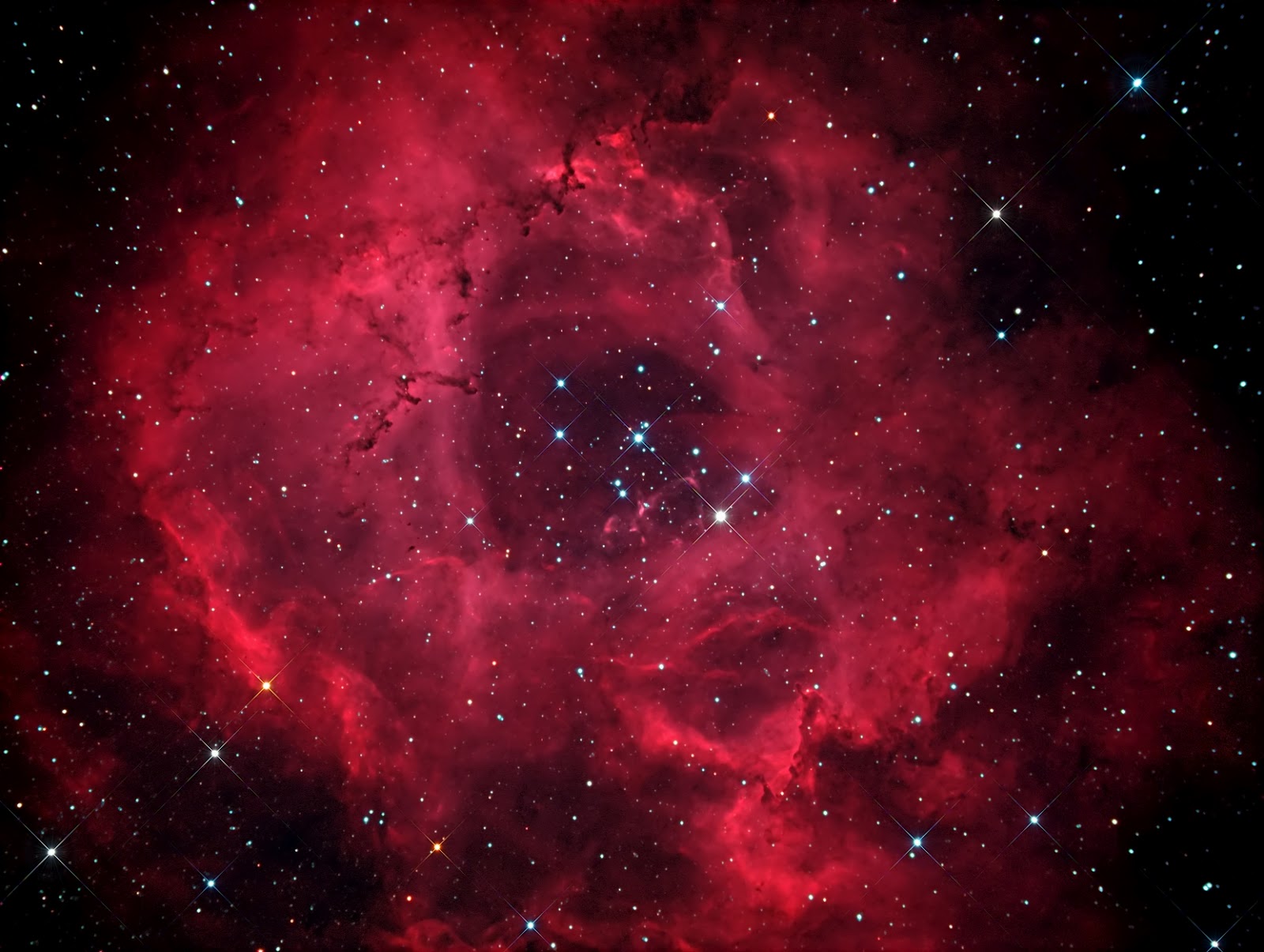
The Rosette Nebula is not the only cosmic cloud of gas and dust to evoke the imagery of flowers -- but it is the most famous. At the edge of a large molecular cloud in Monoceros, some 5,000 light years away, the petals of this rose are actually a stellar nursery whose lovely, symmetric shape is sculpted by the winds and radiation from its central cluster of hot young stars. The stars in the energetic cluster, cataloged as NGC 2244, are only a few million years old, while the central cavity in the Rosette Nebula, cataloged as NGC 2237, is about 50 light-years in diameter. The nebula can be seen firsthand with a small telescope toward the constellation of the Unicorn (Monoceros).
Orion in Gas, Dust, and Stars
The constellation of Orion holds much more than three stars in a row. A deep exposure shows everything from dark nebula to star clusters, all embedded in an extended patch of gaseous wisps in the greater Orion Molecular Cloud Complex. The brightest three stars on the far left are indeed the famous three stars that make up the belt of Orion. Just below Alnitak, the lowest of the three belt stars, is the Flame Nebula, glowing with excited hydrogen gas and immersed in filaments of dark brown dust. Below the frame center and just to the right of Alnitak lies the Horsehead Nebula, a dark indentation of dense dust that has perhaps the most recognized nebular shapes on the sky. On the upper right lies M42, the Orion Nebula, an energetic caldron of tumultuous gas, visible to the unaided eye, that is giving birth to a new open cluster of stars. Immediately to the left of M42 is a prominent bluish reflection nebula sometimes called the Running Man that houses many bright blue stars. The above image, a digitally stitched composite taken over several nights, covers an area with objects that are roughly 1,500 light years away and spans about 75 light years.
Hello
Rich in star clusters and nebulae, the ancient constellation of Auriga, the Charioteer, rides high in northern winter night skies. Composed from narrow and broadband filter data and spanning nearly 8 Full Moons (4 degrees) on the sky, this deep telescopic view recorded in January shows off some of Auriga's celestial bounty. The field includes emission region IC 405 (top left) about 1,500 light-years distant. Also known as the Flaming Star Nebula, its red, convoluted clouds of glowing hydrogen gas are energized by hot O-type star AE Aurigae. IC 410 (top right) is significantly more distant, some 12,000 light-years away. The star forming region is famous for its embedded young star cluster, NGC 1893, and tadpole-shaped clouds of dust and gas. IC 417 and NGC 1931 at the lower right, the Spider and the Fly, are also young star clusters embedded in natal clouds that lie far beyond IC 405. Star cluster NGC 1907 is near the bottom edge of the frame, just right of center. The crowded field of view looks along the plane of our Milky Way galaxy, near the direction of the galactic anticenter.
Many spiral galaxies have bars across their centers. Even our own Milky Way Galaxy is thought to have a modest central bar. Prominently barred spiral galaxy NGC 1073, pictured above, was captured in spectacular detail in this recently released image taken by the orbiting Hubble Space Telescope. Visible are dark filamentary dust lanes, young clusters of bright blue stars, red emission nebulas of glowing hydrogen gas, a long bright bar of stars across the center, and a bright active nucleus that likely houses a supermassive black hole. Light takes about 55 million years to reach us from NGC 1073, which spans about 80,000 light years across. NGC 1073 can be seen with a moderately-sized telescope toward the constellation of the Sea Monster (Cetus), Fortuitously, the above image not only caught the X-ray bright star system IXO 5, visible on the upper left and likely internal to the barred spiral, but three quasars far in the distance.
Monday, February 13, 2012
The space probe that is orbiting around Saturn
Cassini–Huygens is a joint NASA/ESA/ASI spacecraft mission studying the planet Saturn and its many natural satellites since 2004. Launched in 1997 after nearly two decades of gestation, it includes a Saturn orbiter and an atmospheric probe/lander for the moon Titan, although it has also returned data on a wide variety of other things including the Heliosphere, Jupiter, and relativity tests. The Titan probe, Huygens, entered and landed on Titan in 2005. The current end of mission plan is a 2017 Saturn impact.
The complete Cassini–Huygens space probe was launched on October 15, 1997 by a Titan IVB/Centaur, and after a long interplanetary voyage it entered into orbit around Saturn on July 1, 2004. On December 25, 2004, the Huygens probe was separated from the orbiter at approximately 02:00 UTC. It reached Saturn's moon Titan on January 14, 2005, when it descended into Titan's atmosphere, and downward to the surface, radioing scientific information back to the Earth by telemetry. This was the first landing ever accomplished in the outer Solar System. On April 18, 2008, NASA announced a two-year extension of the funding for ground operations of this mission, at which point it was renamed to Cassini Equinox Mission.This was again extended in February 2010 with the Cassini Solstice Mission continuing until 2017. Cassini is the fourth space probe to visit Saturn and the first to enter orbit.
Sixteen European countries and the United States make up the team responsible for designing, building, flying and collecting data from the Cassini orbiter and Huygens probe. The mission is managed by NASA’s Jet Propulsion Laboratory in the United States, where the orbiter was designed and assembled. Development of the Huygens Titan probe was managed by the European Space Research and Technology Centre, whose prime contractor for the probe was the Alcatel company in France. Equipment and instruments for the probe were supplied from many countries. The Italian Space Agency (ASI) provided the Cassini probe's high-gain radio antenna, and a compact and lightweight radar, which acts in multipurpose as a synthetic aperture radar, a radar altimeter, and a radiometer.
Cassini is powered by 72 pounds (32.7 kg )of Plutonium-238 — the heat from the material's radioactive decay is turned into electricity. Huygens was supported by Cassini during cruise, but used chemical batteries when independent.
The spacecraft consists of two main elements: the ASI/NASA Cassini orbiter, named for the Italian-French astronomer Giovanni Domenico Cassini, (also known later as Jean-Dominique Cassini when he became a citizen of France), and the ESA-developed Huygens probe, named for the Dutch astronomer, mathematician and physicist Christiaan Huygens. It was commonly called Saturn Orbiter Titan Probe (SOTP) during gestation, both as a Mariner Mark II mission and generically. Huygens discovered Titan, and Cassini discovered a few more of Saturn's moons.
The spacecraft was originally planned to be the second three-axis stabilized, RTG-powered Mariner Mark II, a class of spacecraft developed for missions beyond the orbit of Mars.
Cassini was developed simultaneously with the Comet Rendezvous Asteroid Flyby (CRAF) spacecraft, but various budget cuts and rescopings of the project forced NASA to terminate CRAF development in order to save Cassini. As a result, the Cassini spacecraft became a more specialized design, canceling the implementation of the Mariner Mark II series.
The spacecraft, including the orbiter and the probe, is the largest and most complex interplanetary spacecraft built to date. The orbiter has a mass of 2,150 kg (4,700 lb), the probe 350 kg (770 lb). With the launch vehicle adapter and 3,132 kg (6,900 lb) of propellants at launch, the spacecraft had a mass of about 5,600 kg (12,000 lb). Only the two Phobos spacecraft sent to Mars by the Soviet Union were heavier.
The Cassini spacecraft is more than 6.8 meters (22 ft) high and more than 4 meters (13 ft) wide. The complexity of the spacecraft is necessitated both by its trajectory (flight path) to Saturn, and by the ambitious program of scientific observations once the spacecraft reaches its destination. Cassini has at least 1,630 interconnected electronic components, 22,000 wire connections, and over 14 kilometers (8.7 mi) of cabling. The core control computer CPU was a redundant MIL-STD-1750A control system.
Now that the Cassini probe is orbiting Saturn, it is between 8.2 and 10.2 astronomical units from the Earth. Because of this, it takes between 68 to 84 minutes for radio signals to travel from Earth to the spacecraft, and vice-versa. Thus, ground controllers cannot give "real-time" instructions to the spacecraft, either for day-to-day operations, or in cases of unexpected events. Even if they responded immediately after becoming aware of a problem, nearly three hours will have passed between the occurrence of the problem itself and the reception of the engineers' response by the satellite
Instruments
Cassini's instrumentation consists of: a synthetic aperture radar mapper, a charge-coupled device imaging system, a visible/infrared mapping spectrometer, a composite infrared spectrometer, a cosmic dust analyzer, a radio and plasma wave experiment, a plasma spectrometer, an ultraviolet imaging spectrograph, a magnetospheric imaging instrument, a magnetometer and an ion/neutral mass spectrometer. Telemetry from the communications antenna and other special transmitters (an S-band transmitter and a dual-frequency Ka-band system) will also be used to make observations of the atmospheres of Titan and Saturn and to measure the gravity fields of the planet and its satellites.
Cassini Plasma Spectrometer (CAPS)
The CAPS is a direct sensing instrument that measures the energy and electrical charge of particles that the instrument encounters, (the number of electrons and protons in the particle). CAPS will measure the molecules originating from Saturn's ionosphere and also determine the configuration of Saturn's magnetic field. CAPS will also investigate plasma in these areas as well as the solar wind within Saturn's magnetosphere
Cosmic Dust Analyzer (CDA)
The CDA is a direct sensing instrument that measures the size, speed, and direction of tiny dust grains near Saturn. Some of these particles are orbiting Saturn, while others may come from other star systems. The CDA on the orbiter is designed to learn more about these mysterious particles, the materials in other celestial bodies and potentially about the origins of the universe.
Composite Infrared Spectrometer (CIRS)
The CIRS is a remote sensing instrument that measures the infrared waves coming from objects to learn about their temperatures, thermal properties, and compositions. Throughout the Cassini–Huygens mission, the CIRS will measure infrared emissions from atmospheres, rings and surfaces in the vast Saturn system. It will map the atmosphere of Saturn in three dimensions to determine temperature and pressure profiles with altitude, gas composition, and the distribution of aerosols and clouds. It will also measure thermal characteristics and the composition of satellite surfaces and rings
Ion and Neutral Mass Spectrometer (INMS)
The INMS is a direct sensing instrument that analyzes charged particles (like protons and heavier ions) and neutral particles (like atoms) near Titan and Saturn to learn more about their atmospheres. INMS is intended also to measure the positive ion and neutral environments of Saturn's icy satellites and rings
Imaging Science Subsystem (ISS)
The ISS is a remote sensing instrument that captures most images in visible light, and also some infrared images and ultraviolet images. The ISS has taken hundreds of thousands of images of Saturn, its rings, and its moons, for return to the Earth by radio telemetry. The ISS has a wide-angle camera (WAC) that takes pictures of large areas, and a narrow-angle camera (NAC) that takes pictures of small areas in fine detail. Each of these cameras uses a sensitive charge-coupled device (CCD) as its electromagnetic wave detector. Each CCD has a 1,024 square array of pixels, 12 μm on a side. Both cameras allow for many data collection modes, including on-chip data compression. Both cameras are fitted with spectral filters that rotate on a wheel—to view different bands within the electromagnetic spectrum ranging from 0.2 to 1.1 μm.
Dual Technique Magnetometer (MAG)
The MAG is a direct sensing instrument that measures the strength and direction of the magnetic field around Saturn. The magnetic fields are generated partly by the intensely hot molten core at Saturn's center. Measuring the magnetic field is one of the ways to probe the core, even though it is far too hot and deep to visit. MAG aims to develop a three-dimensional model of Saturn's magnetosphere, and determine the magnetic state of Titan and its atmosphere, and the icy satellites and their role in the magnetosphere of Saturn
Radar
The onboard radar is a remote active and remote passive sensing instrument that will produce maps of Titan's surface. It measures the height of surface objects (like mountains and canyons) by sending radio signals that bounce off Titan's surface and timing their return. Radio waves can penetrate the thick veil of haze surrounding Titan. The radar will listen for radio waves that Saturn or its moons may be producing
Radio and Plasma Wave Science instrument (RPWS)
The RPWS is a direct and remote sensing instrument that receives and measures radio signals coming from Saturn, including the radio waves given off by the interaction of the solar wind with Saturn and Titan. RPWS is to measure the electric and magnetic wave fields in the interplanetary medium and planetary magnetospheres. It will also determine the electron density and temperature near Titan and in some regions of Saturn's magnetosphere. RPWS studies the configuration of Saturn's magnetic field and its relationship to Saturn Kilometric Radiation (SKR), as well as monitoring and mapping Saturn's ionosphere, plasma, and lightning from Saturn's (and possibly Titan's) atmosphere
Radio Science Subsystem (RSS)
The RSS is a remote sensing instrument that uses radio antennas on Earth to observe the way radio signals from the spacecraft change as they are sent through objects, such as Titan's atmosphere or Saturn's rings, or even behind the Sun. The RSS also studies the compositions, pressures and temperatures of atmospheres and ionospheres, radial structure and particle size distribution within rings, body and system masses and gravitational waves. The instrument uses the spacecraft X-band communication link as well as S-band downlink and Ka-band uplink and downlink
Ultraviolet Imaging Spectrograph (UVIS)
The UVIS is a remote sensing instrument that captures images of the ultraviolet light reflected off an object, such as the clouds of Saturn and/or its rings, to learn more about their structure and composition. Designed to measure ultraviolet light over wavelengths from 55.8 to 190 nm, this instrument is also a valuable tool to help determine the composition, distribution, aerosol particle content and temperatures of their atmospheres. Unlike other types of spectrometer, this sensitive instrument can take both spectral and spatial readings. It is particularly adept at determining the composition of gases. Spatial observations take a wide-by-narrow view, only one pixel tall and 64 pixels across. The spectral dimension is 1,024 pixels per spatial pixel. Also, it can take many images that create movies of the ways in which this material is moved around by other forces
Visible and Infrared Mapping Spectrometer (VIMS)
The VIMS is a remote sensing instrument that captures images using visible and infrared light to learn more about the composition of moon surfaces, the rings, and the atmospheres of Saturn and Titan. It is made up of two cameras in one: one used to measure visible light, the other infrared. VIMS measures reflected and emitted radiation from atmospheres, rings and surfaces over wavelengths from 350 to 5100 nm, to help determine their compositions, temperatures and structures. It also observes the sunlight and starlight that passes through the rings to learn more about their structure. Scientists plan to use VIMS for long-term studies of cloud movement and morphology in the Saturn system, to determine Saturn's weather patterns More info about the Huygens probe later on!
The complete Cassini–Huygens space probe was launched on October 15, 1997 by a Titan IVB/Centaur, and after a long interplanetary voyage it entered into orbit around Saturn on July 1, 2004. On December 25, 2004, the Huygens probe was separated from the orbiter at approximately 02:00 UTC. It reached Saturn's moon Titan on January 14, 2005, when it descended into Titan's atmosphere, and downward to the surface, radioing scientific information back to the Earth by telemetry. This was the first landing ever accomplished in the outer Solar System. On April 18, 2008, NASA announced a two-year extension of the funding for ground operations of this mission, at which point it was renamed to Cassini Equinox Mission.This was again extended in February 2010 with the Cassini Solstice Mission continuing until 2017. Cassini is the fourth space probe to visit Saturn and the first to enter orbit.
Sixteen European countries and the United States make up the team responsible for designing, building, flying and collecting data from the Cassini orbiter and Huygens probe. The mission is managed by NASA’s Jet Propulsion Laboratory in the United States, where the orbiter was designed and assembled. Development of the Huygens Titan probe was managed by the European Space Research and Technology Centre, whose prime contractor for the probe was the Alcatel company in France. Equipment and instruments for the probe were supplied from many countries. The Italian Space Agency (ASI) provided the Cassini probe's high-gain radio antenna, and a compact and lightweight radar, which acts in multipurpose as a synthetic aperture radar, a radar altimeter, and a radiometer.
Cassini is powered by 72 pounds (32.7 kg )of Plutonium-238 — the heat from the material's radioactive decay is turned into electricity. Huygens was supported by Cassini during cruise, but used chemical batteries when independent.
The spacecraft consists of two main elements: the ASI/NASA Cassini orbiter, named for the Italian-French astronomer Giovanni Domenico Cassini, (also known later as Jean-Dominique Cassini when he became a citizen of France), and the ESA-developed Huygens probe, named for the Dutch astronomer, mathematician and physicist Christiaan Huygens. It was commonly called Saturn Orbiter Titan Probe (SOTP) during gestation, both as a Mariner Mark II mission and generically. Huygens discovered Titan, and Cassini discovered a few more of Saturn's moons.
The spacecraft was originally planned to be the second three-axis stabilized, RTG-powered Mariner Mark II, a class of spacecraft developed for missions beyond the orbit of Mars.
Cassini was developed simultaneously with the Comet Rendezvous Asteroid Flyby (CRAF) spacecraft, but various budget cuts and rescopings of the project forced NASA to terminate CRAF development in order to save Cassini. As a result, the Cassini spacecraft became a more specialized design, canceling the implementation of the Mariner Mark II series.
The spacecraft, including the orbiter and the probe, is the largest and most complex interplanetary spacecraft built to date. The orbiter has a mass of 2,150 kg (4,700 lb), the probe 350 kg (770 lb). With the launch vehicle adapter and 3,132 kg (6,900 lb) of propellants at launch, the spacecraft had a mass of about 5,600 kg (12,000 lb). Only the two Phobos spacecraft sent to Mars by the Soviet Union were heavier.
The Cassini spacecraft is more than 6.8 meters (22 ft) high and more than 4 meters (13 ft) wide. The complexity of the spacecraft is necessitated both by its trajectory (flight path) to Saturn, and by the ambitious program of scientific observations once the spacecraft reaches its destination. Cassini has at least 1,630 interconnected electronic components, 22,000 wire connections, and over 14 kilometers (8.7 mi) of cabling. The core control computer CPU was a redundant MIL-STD-1750A control system.
Now that the Cassini probe is orbiting Saturn, it is between 8.2 and 10.2 astronomical units from the Earth. Because of this, it takes between 68 to 84 minutes for radio signals to travel from Earth to the spacecraft, and vice-versa. Thus, ground controllers cannot give "real-time" instructions to the spacecraft, either for day-to-day operations, or in cases of unexpected events. Even if they responded immediately after becoming aware of a problem, nearly three hours will have passed between the occurrence of the problem itself and the reception of the engineers' response by the satellite
Instruments
Cassini's instrumentation consists of: a synthetic aperture radar mapper, a charge-coupled device imaging system, a visible/infrared mapping spectrometer, a composite infrared spectrometer, a cosmic dust analyzer, a radio and plasma wave experiment, a plasma spectrometer, an ultraviolet imaging spectrograph, a magnetospheric imaging instrument, a magnetometer and an ion/neutral mass spectrometer. Telemetry from the communications antenna and other special transmitters (an S-band transmitter and a dual-frequency Ka-band system) will also be used to make observations of the atmospheres of Titan and Saturn and to measure the gravity fields of the planet and its satellites.
Subscribe to:
Posts (Atom)