These are galaxies of the
Hercules
Cluster, an archipelago of
island universes a mere
500 million light-years away.
Also known as
Abell 2151,
this cluster is loaded with gas and dust rich,
star-forming spiral galaxies
but has relatively few elliptical galaxies,
which lack gas and dust and the associated newborn stars.
The colors in
this remarkably deep composite image
clearly show the star forming galaxies with a blue tint and
galaxies with older stellar populations with a yellowish cast.
The sharp picture spans about 3/4 degree across the
cluster center, corresponding to over 6 million light-years at the
cluster's estimated distance.
Diffraction spikes around brighter foreground stars in our
own Milky Way galaxy are produced by the imaging telescope's
mirror support vanes.
In the cosmic vista many galaxies seem to be
colliding or
merging
while others seem
distorted - clear evidence that
cluster galaxies
commonly interact.
In fact,
the Hercules Cluster itself may be seen as the result of
ongoing mergers of smaller galaxy clusters and is thought to be similar to
young galaxy clusters in
the much more distant,
early Universe.
Some maps of the sky
Just some photos.Mostly astronomy pics but other as well.Movie photos etc.The Walkingdead Dead and etc!
Wednesday, June 25, 2014
The Iris Nebula in a Field of Dust
The Iris Nebula.
The striking blue color of the
Iris Nebula is created by light from the bright star
SAO 19158
reflecting off of a dense patch of normally
dark dust.
Not only is the star itself mostly blue, but blue light from the star is preferentially
reflected
by the dust -- the same affect that
makes Earth's sky blue.
The brown tint of the pervasive dust comes partly from
photoluminescence --
dust converting
ultraviolet radiation to
red light.
Cataloged as
NGC 7023, the
Iris Nebula is studied frequently because of the unusual prevalence there of
Polycyclic Aromatic Hydrocarbons (PAHs), complex molecules that are also released on Earth during the incomplete combustion of wood fires.
The bright blue portion of the
Iris Nebula spans about six light years.
The Iris Nebula, lies about 1300 light years distant and
can be found
with a small telescope toward the constellation of
Cepheus.
Sunday, June 22, 2014
Tuesday, June 17, 2014: Planetary nebula Abell 36 lies 780 light years away in the constellation of Virgo. The object is an emission nebula, and while
called a “planetary nebula,” that term misleads, as it refers to
something that has nothing to do with planets. Early observations by
astronomer William Herschel led him to coin the term as this class of
objects resembled planets in his early telescope. Image obtained by Adam
Block and guests of the April 2014 Astrophotography with Adam Block
Experience, at the Mount Lemmon SkyCenter. The facility stands on
Steward Observatory's "sky island" observing site just north of Tucson,
Arizona.
Cosmic Egg
Monday, June 16, 2014: Herschel Space Observatory spotted a ring of dusty material while observing a huge cloud of gas and dust called NGC 7538 with the sharpest resolution to date. The gigantic ring structure sits at the center-top of this image. The roughly egg-shaped ring contains the mass of 500 suns, with a long axis stretching about 35 light-years and its short axis about 25 light-years. Possibly an O-type star created the expanding puff with strong winds or by dying in a supernova, but no trace of an O-type star exists in the center of the ring. Perhaps a big star blew the bubble and moved away from the scene.
Friday, June 13, 2014: On June 11, 2004, Cassini passed Phoebe, the largest of Saturn's outer moons, at an altitude of 1,285 miles (2,068 kilometers), the only close flyby of one of the outer moons of Saturn in the entire Cassini mission. The Cassini team published this montage of two views to mark the 10th anniversary of the Phoebe flyby. The image on the left side shows Cassini's view on approach to Phoebe, while the right side shows the spacecraft's departing perspective. Most of the left-side view was previously released except an area on the upper right side. Most of the view on the right side remained unreleased until now, although the crater at upper left appeared in another published image. Image released June 11, 2014.
Monday, June 9, 2014: A new Hubble image shows IRAS 14568-6304, a young star cloaked in a haze of gas and dust. An area of dark sky appears to contain the young star. This dark region is Circinus molecular cloud, which has a mass around 250,000 times that of the sun, filled with gas, dust and young stars. Two areas within the cloud, Circinus-West and Circinus-East, each have a mass of around 5000 times that of the sun, making them the most prominent star-forming sites in the Circinus cloud. IRAS 14568-6304 has special qualities because it is driving a protostellar jet, which appears here as the "tail" below the star. This jet formed from the leftover gas and dust that the star took from its parent cloud in order to form.
Friday, June 6, 2014: A still image from a video taken by Solar Dynamics Observatory showed tight, bright loops and much longer, softer loops swaying above an active region on the sun, while a darker blob of plasma in their midst was pulled in different directions on May 13-14, 2014. Frames taken in the 171 Angstroms wavelength of extreme ultraviolet light are usually colorized with a bronze tone, but in this case were colored red.
Cosmic Egg
Monday, June 16, 2014: Herschel Space Observatory spotted a ring of dusty material while observing a huge cloud of gas and dust called NGC 7538 with the sharpest resolution to date. The gigantic ring structure sits at the center-top of this image. The roughly egg-shaped ring contains the mass of 500 suns, with a long axis stretching about 35 light-years and its short axis about 25 light-years. Possibly an O-type star created the expanding puff with strong winds or by dying in a supernova, but no trace of an O-type star exists in the center of the ring. Perhaps a big star blew the bubble and moved away from the scene.
Friday, June 13, 2014: On June 11, 2004, Cassini passed Phoebe, the largest of Saturn's outer moons, at an altitude of 1,285 miles (2,068 kilometers), the only close flyby of one of the outer moons of Saturn in the entire Cassini mission. The Cassini team published this montage of two views to mark the 10th anniversary of the Phoebe flyby. The image on the left side shows Cassini's view on approach to Phoebe, while the right side shows the spacecraft's departing perspective. Most of the left-side view was previously released except an area on the upper right side. Most of the view on the right side remained unreleased until now, although the crater at upper left appeared in another published image. Image released June 11, 2014.
Monday, June 9, 2014: A new Hubble image shows IRAS 14568-6304, a young star cloaked in a haze of gas and dust. An area of dark sky appears to contain the young star. This dark region is Circinus molecular cloud, which has a mass around 250,000 times that of the sun, filled with gas, dust and young stars. Two areas within the cloud, Circinus-West and Circinus-East, each have a mass of around 5000 times that of the sun, making them the most prominent star-forming sites in the Circinus cloud. IRAS 14568-6304 has special qualities because it is driving a protostellar jet, which appears here as the "tail" below the star. This jet formed from the leftover gas and dust that the star took from its parent cloud in order to form.
Friday, June 6, 2014: A still image from a video taken by Solar Dynamics Observatory showed tight, bright loops and much longer, softer loops swaying above an active region on the sun, while a darker blob of plasma in their midst was pulled in different directions on May 13-14, 2014. Frames taken in the 171 Angstroms wavelength of extreme ultraviolet light are usually colorized with a bronze tone, but in this case were colored red.
Persistent Saturnian Auroras
Are Saturn's auroras like Earth's?
To help answer this question, the
Hubble Space Telescope and the
Cassini spacecraft monitored Saturn's South Pole
simultaneously as
Cassini closed in
on the gas giant in January 2004.
Hubble snapped images in
ultraviolet light, while Cassini recorded
radio emissions and monitored the
solar wind.
Like on Earth, Saturn's auroras
make total or partial rings around
magnetic poles.
Unlike on Earth, however,
Saturn's auroras persist for days, as opposed to only minutes on
Earth.
Although surely created by
charged particles entering the atmosphere,
Saturn's auroras also appear to be
more closely modulated by the
solar wind than either Earth's or
Jupiter's auroras.
The above sequence shows three Hubble images of
Saturn
each taken two days apart.
Wednesday, June 11, 2014
New Horizon
Before New Horizon there was many space probe plan to flyby Pluto but they wasn't funded. The last one plan was to be two space probe send to Pluto so they could take photos and other spectrum of both hemispheres of Pluto and its moons. It was to get to Pluto in 2010 but it was cancel by congress and than New Horizon was pick and they just move the instruments from the Pluto Kuiper Express!
to New Horizons is a space probe launched by NASA on 19 January 2006 to study the dwarf planet Pluto and the Kuiper belt. It is expected to be the first spacecraft to fly by and study Pluto and its moons, Charon, Nix, Hydra, Kerberos, and Styx, with an estimated arrival date at the Pluto–Charon system of 14 July 2015. As of 21 January 2014, its distance from Pluto is about 4.29 AU (about 29.33 AU from Earth), with radio signals taking 4 hours to travel to the spacecraft from Earth (an 8 hour round trip).
Launched directly into an Earth-and-solar-escape trajectory with an Earth-relative velocity of about 36,373 mph it set the record for the highest velocity of a human-made object from Earth. Using a combination of monopropellant and gravity assist, it flew by the orbit of Mars on 7 April 2006, Jupiter on 28 February 2007, the orbit of Saturn on 8 June 2008; and the orbit of Uranus on 18 March 2011. Its secondary mission is to fly by one or more other Kuiper belt objects (should a suitable target be available) then the heliosphere. It is expected to become the fifth interstellar probe and second fastest in the history of space exploration.But it wouldn't reach the two Voyagers 1 and 2.
About an ounce of Clyde Tombaugh's ashes are aboard the spacecraft, to commemorate his discovery of Pluto in 1930.
On its was to Pluto it fly by Jupiter with better cameras that was on Voyager.New Horizons used LORRI to take its first photographs of Jupiter on 4 September 2006 from a distance of 291 million kilometres (181 million miles). More detailed exploration of the system began in January 2007 with an infrared image of the moon Callisto as well as several black and white images of the planet itself. New Horizons received a Jupiter gravity assist with a closest approach on 28 February 2007 when it was 1.4 million miles) from the planet. The flyby increased New Horizons' speed by 9,000 miles per hour accelerating the probe 52,000 miles per hour relative to the Sun and shortening its voyage to Pluto by three years.
The flyby was the center of a 4-month intensive observation campaign lasting from January to June. Being an ever-changing scientific target, Jupiter was observed intermittently since the end of the Galileo mission. Knowledge about the planet benefited from the fact that New Horizons instruments were built using the latest technology, especially in the area of cameras, representing a significant improvement over Galileo's cameras, which were evolved versions of Voyager cameras which, in turn, were evolved Mariner cameras. The Jupiter encounter also served as a shakedown and dress rehearsal for the Pluto encounter. Because of the much shorter distance from Jupiter to Earth, the communications link can transmit multiple loadings of the memory buffer; thus the mission actually returned more data from the Jovian system than it is expected to transmit from Pluto.
One of the main goals during the Jupiter encounter was observing the planets atmospheric conditions and analyzing the structure and composition of its clouds. Heat induced lightning strikes in the polar regions and "waves" that indicate violent storm activity were observed and measured. The Little Red Spot, spanning up to 70% of Earth's diameter, was imaged from up close for the first time.
Observing from different angles and illumination conditions New Horizons took detailed images of Jupiter's faint ring system discovering debris left over from recent collisions within the rings or from some other unexplained phenomena. The search for undiscovered moons within the rings showed no results. Travelling through the planet's magnetosphere New Horizons collected valuable particle readings. "Bubbles" of plasma which are believed to be formed from material ejected by the moon Io were noticed in the magnetotail.
After passing bu Jupiter the space probe was place in Hibernation since there wasn't anything to see except Pluto which was many years away. Redundant components as well as guidance and control systems will be shut down in order to extend their life cycle, decrease operational costs and free the Deep Space Network for other missions. During hibernation mode, the onboard computer monitors the probe's systems and transmits a signal back to Earth: a "green" code if everything is functioning as expected or a "red" code if the mission control's assistance is needed. The probe will be activated for about two months a year so that the instruments can be calibrated and the systems checked. New Horizons first hibernation mode cycle started on 28 June 2007.
After astronomers announced the discovery of two new moons in the Pluto system, Kerberos and Styx, mission planners started contemplating the possibility of the probe running into unseen debris and dust left over from earlier collisions with the moons. A study based on 18 months of computer simulations, Earth-based telescope observations and occultations of the Pluto system revealed that the possibility of a catastrophic collision with debris or dust is less than 0.3% if the probe is to continue on its present course. If the hazard increases, New Horizons will utilize one of two possible contingency plans, the so-called SHBOTs (Safe Haven by Other Trajectories): the probe could continue on its present trajectory with the antenna facing the incoming particles so the more vital systems would be protected, or, it could position its antenna and make a course correction that would take it just 3000 km from the surface of Pluto where it's expected that the atmospheric drag cleaned the surrounding space of possible debris.
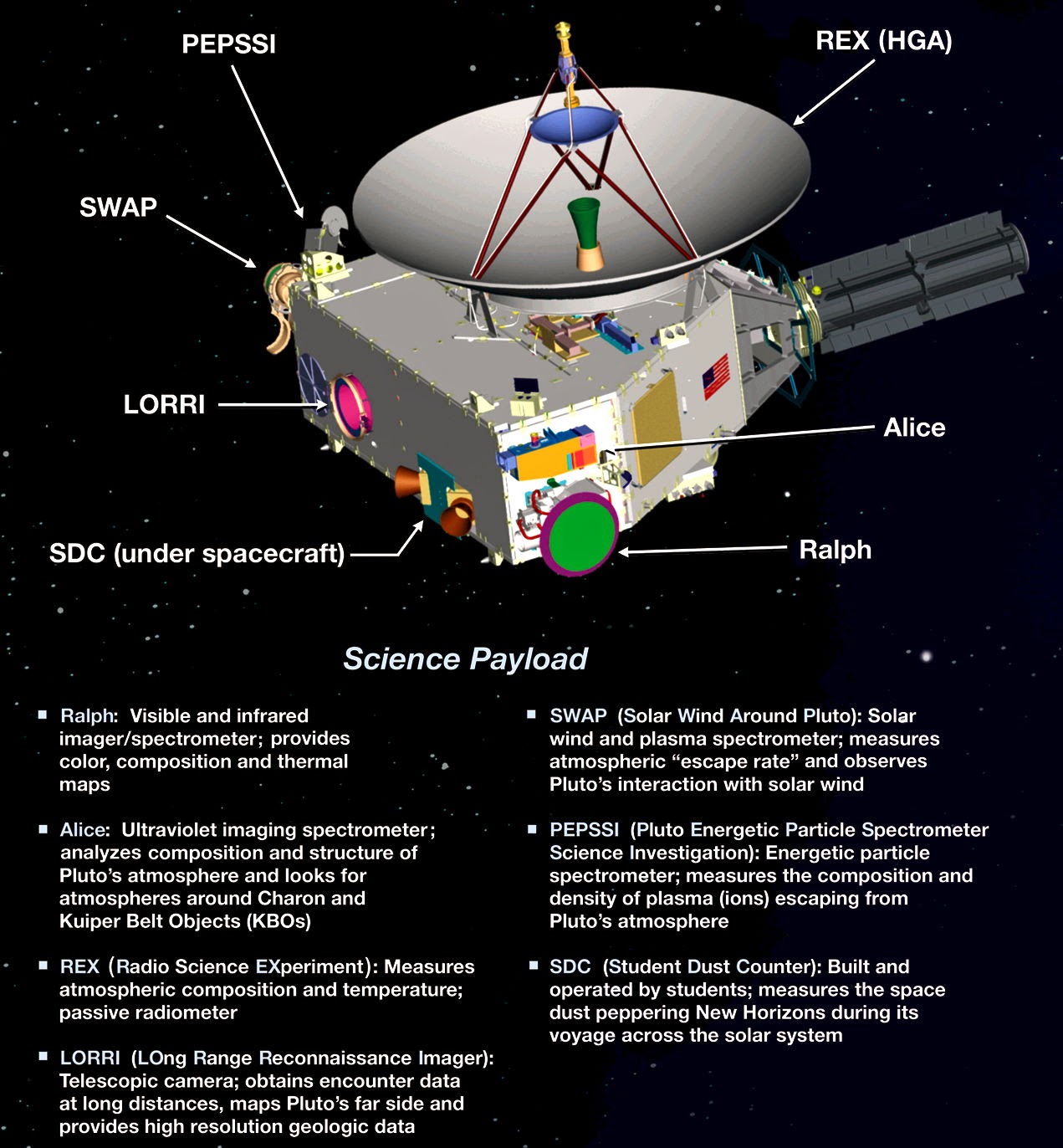
The spacecraft carries seven scientific instruments. Total mass is 31 kg (68 lb) and rated power is 21 watts (though not all instruments operate simultaneously).
Fundamental physics-Pioneer Anomaly
It was shown that New Horizons may be used to test the Pioneer Anomaly issue.
Long Range Reconnaissance Imager (LORRI)
LORRI is a long focal length imager designed for high resolution and responsivity at visible wavelengths. The instrument is equipped with a high-resolution 1024×1024 monochromatic CCD imager with a 208.3 mm (8.20 in) aperture giving a resolution of 5 μrad (~1 asec). The CCD is chilled far below freezing by a passive radiator on the antisolar face of the spacecraft. This temperature differential requires insulation, and isolation from the rest of the structure. The Ritchey-Chretien mirrors and metering structure are made of silicon carbide, to boost stiffness, reduce weight, and prevent warping at low temperatures. The optical elements sit in a composite light shield, and mount with titanium and fibreglass for thermal isolation. Overall mass is 8.6 kg (19 lb), with the Optical tube assembly (OTA) weighing about 5.6 kg (12 lb), for one of the largest silicon-carbide telescopes yet flown
Pluto Exploration Remote Sensing Investigation (PERSI)
This consists of two instruments: The Ralph telescope, 6 cm (2.4 in) in aperture, with two separate channels: a visible-light CCD imager (MVIC- Multispectral Visible Imaging Camera) with broadband and color channels, and a near-infrared imaging spectrometer, LEISA (Linear Etalon Imaging Spectral Array). LEISA is derived from a similar instrument on the EO-1 mission. The second instrument is an ultraviolet imaging spectrometer, Alice. Alice resolves 1,024 wavelength bands in the far and extreme ultraviolet (from 50–180 nm), over 32 view fields. Its goal is to view the atmospheric makeup of Pluto. This Alice is derived from an Alice on the Rosetta mission. Ralph, designed afterwards, was named after Alice's husband on The Honeymooners. Ralph and Alice are names, not acronyms.
Plasma and high energy particle spectrometer suite (PAM)
PAM consists of two instruments: SWAP (Solar Wind At Pluto), a toroidal electrostatic analyzer and retarding potential analyzer, and PEPSSI (Pluto Energetic Particle Spectrometer Science Investigation), a time of flight ion and electron sensor. SWAP measures particles of up to 6.5 keV, PEPSSI goes up to 1 MeV. Because of the tenuous solar wind at Pluto's distance, the SWAP instrument has the largest aperture of any such instrument ever flown.
Radio Science Experiment (REX)
REX will use an ultrastable crystal oscillator (essentially a calibrated crystal in a miniature oven) and some additional electronics to conduct radio science investigations using the communications channels. These are small enough to fit on a single card. Since there are two redundant communications subsystems, there are two, identical REX circuit boards.
Venetia Burney Student Dust Counter (VBSDC)
Built by students at the University of Colorado at Boulder, the Student Dust Counter will operate continuously through the trajectory to make dust measurements. It consists of a detector panel, about 18 by 12 inches (460 mm × 300 mm), mounted on the antisolar face of the spacecraft (the ram direction), and an electronics box within the spacecraft. The detector contains fourteen polyvinylidene difluoride (PVDF) panels, twelve science and two reference, which generate voltage when impacted. Effective collecting area is 0.125 m2 (1.35 sq ft). No dust counter has operated past the orbit of Uranus; models of dust in the outer Solar System, especially the Kuiper belt, are speculative. VBSDC is always turned on measuring the masses of the interplanetary and interstellar dust particles (in the range of nano- and picograms) as they collide with the PVDF panels mounted on the New Horizons spacecraft. The measured data shall greatly contribute to the understanding of the dust spectra of the Solar System. The dust spectra can then be compared with those observed via telescope of other stars, giving new clues as to where earthlike planets can be found in our universe. The dust counter is named for Venetia Burney, who first suggested the name "Pluto" at the age of 11. An interesting thirteen-minute short film about VBSDC garnered an Emmy award for student achievement in 2006
The main Flyby 2015!
Observations of Pluto, with the onboard LORRI imager plus Ralph telescope, will begin about 6 months prior to closest approach. The targets will be only a few pixels across. 70 days out, resolution will exceed the Hubble Space Telescope's resolution, lasting another two weeks after the flyby. This should detect any rings or any additional moons (eventually down to 2 km diameter), for avoidance and targeting maneuvers, and observation scheduling. Long-range imaging will include 40 km (25 mi) mapping of Pluto and Charon 3.2 days out. This is half the rotation period of Pluto–Charon and will allow imaging of the side of both bodies that will be facing away from the spacecraft at closest approach. Coverage will repeat twice per day, to search for changes due to snows or cryovolcanism. Still, due to Pluto's tilt and rotation, a portion of the northern hemisphere will be in shadow at all times.
During the flyby, LORRI should be able to obtain select images with resolution as high as 50 m/px (if closest distance is around 10,000 km), and MVIC should obtain 4-color global dayside maps at 1.6 km resolution. LORRI and MVIC will attempt to overlap their respective coverage areas to form stereo pairs. LEISA will obtain hyperspectral near-infrared maps at 7 km/px globally and 0.6 km/pixel for selected areas. Meanwhile, Alice will characterize the atmosphere, both by emissions of atmospheric molecules (airglow), and by dimming of background stars as they pass behind Pluto (occultation).
During and after closest approach, SWAP and PEPSSI will sample the high atmosphere and its effects on the solar wind. VBSDC will search for dust, inferring meteoroid collision rates and any invisible rings. REX will perform active and passive radio science. Ground stations on Earth will transmit a powerful radio signal as New Horizons passes behind Pluto's disk, then emerges on the other side. The communications dish will measure the disappearance and reappearance of the radio occultation signal. The results will resolve Pluto's diameter (by their timing) and atmospheric density and composition (by their weakening and strengthening pattern). (Alice can perform similar occultations, using sunlight instead of radio beacons.) Previous missions had the spacecraft transmit through the atmosphere, to Earth ("downlink"). Low power and extreme distance means New Horizons will be the first such "uplink" mission. Pluto's mass and mass distribution will be evaluated by their tug on the spacecraft. As the spacecraft speeds up and slows down, the radio signal will experience a Doppler shift. The Doppler shift will be measured by comparison with the ultrastable oscillator in the communications electronics.
Reflected sunlight from Charon will allow some imaging observations of the nightside. Backlighting by the Sun will highlight any rings or atmospheric hazes. REX will perform radiometry of the nightside.
Initial, highly-compressed images will be transmitted within days. The science team will select the best images for public release. Uncompressed images will take about nine months[citation needed] to transmit, depending on Deep Space Network traffic. It may turn out, however, that fewer months will be needed. The spacecraft link is proving stronger than expected, and it is possible that both downlink channels may be ganged together to nearly double the data rate.
To bad its just a flyby but a orbiter would take to long to get there,they was dealing with nature.Pluto was moving away from the Sun this means that there would be no atmosphere to study if a orbiter was send plus with a travel time of about 38 years. During Pluto lifetime ,it lost up to 14 feet of it surface during these close approaches to the Sun.AT time Pluto get closer to the Sun than Neptune( here its distance from our sun-4.4–7.4 billion km) Pluto act more like a comet than a planet. They think during the formation of our solar system that Neptune and Uranus form between Jupiter ans Saturn and when Neptune and Uranus shift their position with in the solar system to their current position they send many Pluto size object toward the inner solar system and since they thing these pluto and Kuiper belt objects are made out of 80%water this give the Earth,Venus,Mars, Mercury with large amount of water. Mercury water was gone in no time and Venus,Mars during this time to the current time lost their water (Most of it for Mars and all of it for Venus) Earth was the only one that keep all of time!
to New Horizons is a space probe launched by NASA on 19 January 2006 to study the dwarf planet Pluto and the Kuiper belt. It is expected to be the first spacecraft to fly by and study Pluto and its moons, Charon, Nix, Hydra, Kerberos, and Styx, with an estimated arrival date at the Pluto–Charon system of 14 July 2015. As of 21 January 2014, its distance from Pluto is about 4.29 AU (about 29.33 AU from Earth), with radio signals taking 4 hours to travel to the spacecraft from Earth (an 8 hour round trip).
Launched directly into an Earth-and-solar-escape trajectory with an Earth-relative velocity of about 36,373 mph it set the record for the highest velocity of a human-made object from Earth. Using a combination of monopropellant and gravity assist, it flew by the orbit of Mars on 7 April 2006, Jupiter on 28 February 2007, the orbit of Saturn on 8 June 2008; and the orbit of Uranus on 18 March 2011. Its secondary mission is to fly by one or more other Kuiper belt objects (should a suitable target be available) then the heliosphere. It is expected to become the fifth interstellar probe and second fastest in the history of space exploration.But it wouldn't reach the two Voyagers 1 and 2.
About an ounce of Clyde Tombaugh's ashes are aboard the spacecraft, to commemorate his discovery of Pluto in 1930.
On its was to Pluto it fly by Jupiter with better cameras that was on Voyager.New Horizons used LORRI to take its first photographs of Jupiter on 4 September 2006 from a distance of 291 million kilometres (181 million miles). More detailed exploration of the system began in January 2007 with an infrared image of the moon Callisto as well as several black and white images of the planet itself. New Horizons received a Jupiter gravity assist with a closest approach on 28 February 2007 when it was 1.4 million miles) from the planet. The flyby increased New Horizons' speed by 9,000 miles per hour accelerating the probe 52,000 miles per hour relative to the Sun and shortening its voyage to Pluto by three years.
The flyby was the center of a 4-month intensive observation campaign lasting from January to June. Being an ever-changing scientific target, Jupiter was observed intermittently since the end of the Galileo mission. Knowledge about the planet benefited from the fact that New Horizons instruments were built using the latest technology, especially in the area of cameras, representing a significant improvement over Galileo's cameras, which were evolved versions of Voyager cameras which, in turn, were evolved Mariner cameras. The Jupiter encounter also served as a shakedown and dress rehearsal for the Pluto encounter. Because of the much shorter distance from Jupiter to Earth, the communications link can transmit multiple loadings of the memory buffer; thus the mission actually returned more data from the Jovian system than it is expected to transmit from Pluto.
One of the main goals during the Jupiter encounter was observing the planets atmospheric conditions and analyzing the structure and composition of its clouds. Heat induced lightning strikes in the polar regions and "waves" that indicate violent storm activity were observed and measured. The Little Red Spot, spanning up to 70% of Earth's diameter, was imaged from up close for the first time.
Observing from different angles and illumination conditions New Horizons took detailed images of Jupiter's faint ring system discovering debris left over from recent collisions within the rings or from some other unexplained phenomena. The search for undiscovered moons within the rings showed no results. Travelling through the planet's magnetosphere New Horizons collected valuable particle readings. "Bubbles" of plasma which are believed to be formed from material ejected by the moon Io were noticed in the magnetotail.
After passing bu Jupiter the space probe was place in Hibernation since there wasn't anything to see except Pluto which was many years away. Redundant components as well as guidance and control systems will be shut down in order to extend their life cycle, decrease operational costs and free the Deep Space Network for other missions. During hibernation mode, the onboard computer monitors the probe's systems and transmits a signal back to Earth: a "green" code if everything is functioning as expected or a "red" code if the mission control's assistance is needed. The probe will be activated for about two months a year so that the instruments can be calibrated and the systems checked. New Horizons first hibernation mode cycle started on 28 June 2007.
After astronomers announced the discovery of two new moons in the Pluto system, Kerberos and Styx, mission planners started contemplating the possibility of the probe running into unseen debris and dust left over from earlier collisions with the moons. A study based on 18 months of computer simulations, Earth-based telescope observations and occultations of the Pluto system revealed that the possibility of a catastrophic collision with debris or dust is less than 0.3% if the probe is to continue on its present course. If the hazard increases, New Horizons will utilize one of two possible contingency plans, the so-called SHBOTs (Safe Haven by Other Trajectories): the probe could continue on its present trajectory with the antenna facing the incoming particles so the more vital systems would be protected, or, it could position its antenna and make a course correction that would take it just 3000 km from the surface of Pluto where it's expected that the atmospheric drag cleaned the surrounding space of possible debris.
The spacecraft carries seven scientific instruments. Total mass is 31 kg (68 lb) and rated power is 21 watts (though not all instruments operate simultaneously).
Fundamental physics-Pioneer Anomaly
It was shown that New Horizons may be used to test the Pioneer Anomaly issue.
Long Range Reconnaissance Imager (LORRI)
LORRI is a long focal length imager designed for high resolution and responsivity at visible wavelengths. The instrument is equipped with a high-resolution 1024×1024 monochromatic CCD imager with a 208.3 mm (8.20 in) aperture giving a resolution of 5 μrad (~1 asec). The CCD is chilled far below freezing by a passive radiator on the antisolar face of the spacecraft. This temperature differential requires insulation, and isolation from the rest of the structure. The Ritchey-Chretien mirrors and metering structure are made of silicon carbide, to boost stiffness, reduce weight, and prevent warping at low temperatures. The optical elements sit in a composite light shield, and mount with titanium and fibreglass for thermal isolation. Overall mass is 8.6 kg (19 lb), with the Optical tube assembly (OTA) weighing about 5.6 kg (12 lb), for one of the largest silicon-carbide telescopes yet flown
Pluto Exploration Remote Sensing Investigation (PERSI)
This consists of two instruments: The Ralph telescope, 6 cm (2.4 in) in aperture, with two separate channels: a visible-light CCD imager (MVIC- Multispectral Visible Imaging Camera) with broadband and color channels, and a near-infrared imaging spectrometer, LEISA (Linear Etalon Imaging Spectral Array). LEISA is derived from a similar instrument on the EO-1 mission. The second instrument is an ultraviolet imaging spectrometer, Alice. Alice resolves 1,024 wavelength bands in the far and extreme ultraviolet (from 50–180 nm), over 32 view fields. Its goal is to view the atmospheric makeup of Pluto. This Alice is derived from an Alice on the Rosetta mission. Ralph, designed afterwards, was named after Alice's husband on The Honeymooners. Ralph and Alice are names, not acronyms.
Plasma and high energy particle spectrometer suite (PAM)
PAM consists of two instruments: SWAP (Solar Wind At Pluto), a toroidal electrostatic analyzer and retarding potential analyzer, and PEPSSI (Pluto Energetic Particle Spectrometer Science Investigation), a time of flight ion and electron sensor. SWAP measures particles of up to 6.5 keV, PEPSSI goes up to 1 MeV. Because of the tenuous solar wind at Pluto's distance, the SWAP instrument has the largest aperture of any such instrument ever flown.
Radio Science Experiment (REX)
REX will use an ultrastable crystal oscillator (essentially a calibrated crystal in a miniature oven) and some additional electronics to conduct radio science investigations using the communications channels. These are small enough to fit on a single card. Since there are two redundant communications subsystems, there are two, identical REX circuit boards.
Venetia Burney Student Dust Counter (VBSDC)
Built by students at the University of Colorado at Boulder, the Student Dust Counter will operate continuously through the trajectory to make dust measurements. It consists of a detector panel, about 18 by 12 inches (460 mm × 300 mm), mounted on the antisolar face of the spacecraft (the ram direction), and an electronics box within the spacecraft. The detector contains fourteen polyvinylidene difluoride (PVDF) panels, twelve science and two reference, which generate voltage when impacted. Effective collecting area is 0.125 m2 (1.35 sq ft). No dust counter has operated past the orbit of Uranus; models of dust in the outer Solar System, especially the Kuiper belt, are speculative. VBSDC is always turned on measuring the masses of the interplanetary and interstellar dust particles (in the range of nano- and picograms) as they collide with the PVDF panels mounted on the New Horizons spacecraft. The measured data shall greatly contribute to the understanding of the dust spectra of the Solar System. The dust spectra can then be compared with those observed via telescope of other stars, giving new clues as to where earthlike planets can be found in our universe. The dust counter is named for Venetia Burney, who first suggested the name "Pluto" at the age of 11. An interesting thirteen-minute short film about VBSDC garnered an Emmy award for student achievement in 2006
The main Flyby 2015!
Observations of Pluto, with the onboard LORRI imager plus Ralph telescope, will begin about 6 months prior to closest approach. The targets will be only a few pixels across. 70 days out, resolution will exceed the Hubble Space Telescope's resolution, lasting another two weeks after the flyby. This should detect any rings or any additional moons (eventually down to 2 km diameter), for avoidance and targeting maneuvers, and observation scheduling. Long-range imaging will include 40 km (25 mi) mapping of Pluto and Charon 3.2 days out. This is half the rotation period of Pluto–Charon and will allow imaging of the side of both bodies that will be facing away from the spacecraft at closest approach. Coverage will repeat twice per day, to search for changes due to snows or cryovolcanism. Still, due to Pluto's tilt and rotation, a portion of the northern hemisphere will be in shadow at all times.
During the flyby, LORRI should be able to obtain select images with resolution as high as 50 m/px (if closest distance is around 10,000 km), and MVIC should obtain 4-color global dayside maps at 1.6 km resolution. LORRI and MVIC will attempt to overlap their respective coverage areas to form stereo pairs. LEISA will obtain hyperspectral near-infrared maps at 7 km/px globally and 0.6 km/pixel for selected areas. Meanwhile, Alice will characterize the atmosphere, both by emissions of atmospheric molecules (airglow), and by dimming of background stars as they pass behind Pluto (occultation).
During and after closest approach, SWAP and PEPSSI will sample the high atmosphere and its effects on the solar wind. VBSDC will search for dust, inferring meteoroid collision rates and any invisible rings. REX will perform active and passive radio science. Ground stations on Earth will transmit a powerful radio signal as New Horizons passes behind Pluto's disk, then emerges on the other side. The communications dish will measure the disappearance and reappearance of the radio occultation signal. The results will resolve Pluto's diameter (by their timing) and atmospheric density and composition (by their weakening and strengthening pattern). (Alice can perform similar occultations, using sunlight instead of radio beacons.) Previous missions had the spacecraft transmit through the atmosphere, to Earth ("downlink"). Low power and extreme distance means New Horizons will be the first such "uplink" mission. Pluto's mass and mass distribution will be evaluated by their tug on the spacecraft. As the spacecraft speeds up and slows down, the radio signal will experience a Doppler shift. The Doppler shift will be measured by comparison with the ultrastable oscillator in the communications electronics.
Reflected sunlight from Charon will allow some imaging observations of the nightside. Backlighting by the Sun will highlight any rings or atmospheric hazes. REX will perform radiometry of the nightside.
Initial, highly-compressed images will be transmitted within days. The science team will select the best images for public release. Uncompressed images will take about nine months[citation needed] to transmit, depending on Deep Space Network traffic. It may turn out, however, that fewer months will be needed. The spacecraft link is proving stronger than expected, and it is possible that both downlink channels may be ganged together to nearly double the data rate.
To bad its just a flyby but a orbiter would take to long to get there,they was dealing with nature.Pluto was moving away from the Sun this means that there would be no atmosphere to study if a orbiter was send plus with a travel time of about 38 years. During Pluto lifetime ,it lost up to 14 feet of it surface during these close approaches to the Sun.AT time Pluto get closer to the Sun than Neptune( here its distance from our sun-4.4–7.4 billion km) Pluto act more like a comet than a planet. They think during the formation of our solar system that Neptune and Uranus form between Jupiter ans Saturn and when Neptune and Uranus shift their position with in the solar system to their current position they send many Pluto size object toward the inner solar system and since they thing these pluto and Kuiper belt objects are made out of 80%water this give the Earth,Venus,Mars, Mercury with large amount of water. Mercury water was gone in no time and Venus,Mars during this time to the current time lost their water (Most of it for Mars and all of it for Venus) Earth was the only one that keep all of time!
Tuesday, June 10, 2014
Pluto! Planet or not!?
It would be must-see TV for space geeks everywhere — two big-name
scientists debating whether or not Pluto should be reinstated as the
solar system's ninth "true" planet.
Alan Stern, the principal investigator of NASA's New Horizons mission to Pluto, has challenged astrophysicist Neil deGrasse Tyson to just such a debate, NBCNews reported last week.
"I am challenging him to the equivalent of the 'Thrilla in Manila,'" Stern told NBCNews. "Before New Horizons gets to Pluto, I want him to accept the debate."
That gives Tyson — the host of "Cosmos: A Spacetime Odyssey," a TV series that aired this spring on Fox and the National Geographic Channel — about a year to work the proposed debate into his schedule, if he so chooses. New Horizons is scheduled to fly by the Pluto system in July 2015, giving astronomers their first-ever up-close look at the frigid world and its five known moons.
Pluto was regarded as the solar system's ninth planet for more than 75 years after its 1930 discovery. But in 2006, the International Astronomical Union (IAU) — the organization responsible for giving "official" scientific names to celestial objects — came up with a new definiton of "planet," and Pluto didn't make the cut. (It hasn't sufficiently "cleared its neighborhood" of other objects, IAU officials said.)
So Pluto was demoted to the newly created category of "dwarf planet," a status it shares with several other large bodies in the frigid, faraway Kuiper Belt. Some scientists, such as Tyson, have expressed support for the decision, while others are not at all happy about it.
Stern is perhaps the most prominent and passionate of the dissenters. He has no problem with the "dwarf planet" designation but believes that dwarfs should enjoy the same status as rocky worlds like Earth and gas giants such as Jupiter.
Alan Stern, the principal investigator of NASA's New Horizons mission to Pluto, has challenged astrophysicist Neil deGrasse Tyson to just such a debate, NBCNews reported last week.
"I am challenging him to the equivalent of the 'Thrilla in Manila,'" Stern told NBCNews. "Before New Horizons gets to Pluto, I want him to accept the debate."
That gives Tyson — the host of "Cosmos: A Spacetime Odyssey," a TV series that aired this spring on Fox and the National Geographic Channel — about a year to work the proposed debate into his schedule, if he so chooses. New Horizons is scheduled to fly by the Pluto system in July 2015, giving astronomers their first-ever up-close look at the frigid world and its five known moons.
Pluto was regarded as the solar system's ninth planet for more than 75 years after its 1930 discovery. But in 2006, the International Astronomical Union (IAU) — the organization responsible for giving "official" scientific names to celestial objects — came up with a new definiton of "planet," and Pluto didn't make the cut. (It hasn't sufficiently "cleared its neighborhood" of other objects, IAU officials said.)
So Pluto was demoted to the newly created category of "dwarf planet," a status it shares with several other large bodies in the frigid, faraway Kuiper Belt. Some scientists, such as Tyson, have expressed support for the decision, while others are not at all happy about it.
Stern is perhaps the most prominent and passionate of the dissenters. He has no problem with the "dwarf planet" designation but believes that dwarfs should enjoy the same status as rocky worlds like Earth and gas giants such as Jupiter.
Saturday, May 31, 2014
Voyager 1 and 2
Voyager2
Voyager 2 is a 722 kg (1,592 lb) space probe launched by NASA on August 20, 1977 to study the outer Solar System and eventually interstellar space. It was actually launched before Voyager 1, but Voyager 1 moved faster and eventually passed it. Voyager 2 has been operating for 36 years, 9 months and 11 days as of 31 May 2014, and the Deep Space Network is still receiving its data transmissions.
At a distance of 104.44 AU (1.562×10¹⁰ km) as of 31 May 2014 from Earth, it is one of the most distant human made objects (along with Voyager 1, Pioneer 10 and Pioneer 11). Voyager 2 is part of the Voyager program with its identical sister craft Voyager 1, and is in extended mission, tasked with locating and studying the boundaries of the Solar System, including the Kuiper belt, the heliosphere and interstellar space.
The primary mission ended December 31, 1989 after encountering the Jovian system in 1979, Saturnian system in 1981, Uranian system in 1986, and the Neptunian system in 1989. It is still the only spacecraft to have visited the two outer giant planets Uranus and Neptune. The probe is now moving at a velocity of 15.428 km/s relative to the Sun.
Some history
Conceived in the 1960s, a Grand tour proposal to study the outer planets, prompted NASA to begin work on a mission in the early 1970s. The development of the interplanetary probes coincided with an alignment of the planets, making possible a mission to the outer Solar System by taking advantage of the then-new technique of gravity assist.
It was determined that utilizing gravity assists would enable a single probe to visit the four gas giants (Jupiter, Saturn, Uranus, and Neptune) while requiring a minimal amount of propellant and a shorter transit duration between planets. Originally, Voyager 2 was planned as Mariner 12 of the Mariner program; however, due to congressional budget cuts(a lot of short sight people), the mission was scaled back to be a flyby of Jupiter and Saturn, and renamed the Mariner Jupiter-Saturn probes. As the program progressed, the name was later changed to Voyager as the probe designs began to differ greatly from previous Mariner missions.
Upon a successful flyby of the Saturnian moon Titan, by Voyager 1, Voyager 2 would get a mission extension to send the probe on towards Uranus and Neptune, ultimately realizing the vision of the Planetary Grand Tour. This could happen because one time time history of human all the planet would be on the same side of the Sun. This happen once every 200 to 300 years!(when jupiter and Saturn Uranus and Neptune)
Each space probe has a record with sounds of the Earth and some photos.
Each of them is power by RTGs( radioisotope thermoelectric generators).Each RTG includes 24 pressed plutonium oxide spheres and provides enough heat to generate approximately 157 watts of power at launch. Collectively, the RTGs supply the spacecraft with 470 watts at launch and will allow operations to continue until at least 2020.
It flyby Planet Jupiter
The closest approach to Jupiter occurred on July 9, 1979. It came within 570,000 km (350,000 mi) of the planet's cloud tops. It discovered a few rings around Jupiter, as well as volcanic activity on the moon Io.
The Great Red Spot was revealed as a complex storm moving in a counterclockwise direction. An array of other smaller storms and eddies were found throughout the banded clouds.
Discovery of active volcanism on Io was easily the greatest unexpected discovery at Jupiter. It was the first time active volcanoes had been seen on another body in the Solar System. Together, the Voyagers observed the eruption of nine volcanoes on Io, and there is evidence that other eruptions occurred between the two Voyager fly-bys.
The moon Europa displayed a large number of intersecting linear features in the low-resolution photos from Voyager 1. At first, scientists believed the features might be deep cracks, caused by crustal rifting or tectonic processes. The closer high-resolution photos from Voyager 2, however, left scientists puzzled: The features were so lacking in topographic relief that as one scientist described them, they "might have been painted on with a felt marker." Europa is internally active due to tidal heating at a level about one-tenth that of Io. Europa is thought to have a thin crust (less than 30 km (19 mi) thick) of water ice, possibly floating on a 50-kilometer-deep (30 mile) ocean.
Two new, small satellites, Adrastea and Metis, were found orbiting just outside the ring. A third new satellite, Thebe, was discovered between the orbits of Amalthea and Io.
Flyby of Saturn
The closest approach to Saturn occurred on August 26, 1981.
While passing behind Saturn (as viewed from Earth), Voyager 2 probed Saturn's upper atmosphere with its radio link to gather information on atmospheric temperature and density profiles. Voyager 2 found that at the uppermost pressure levels (seven kilopascals of pressure), Saturn's temperature was 70 kelvins (−203 °C), while at the deepest levels measured (120 kilopascals) the temperature increased to 143 K (−130 °C). The north pole was found to be 10 kelvins cooler, although this may be seasonal
After the fly-by of Saturn, the camera platform of Voyager 2 locked up briefly, putting plans to officially extend the mission to Uranus and Neptune in jeopardy. Fortunately, the mission's engineers were able to fix the problem (caused by an overuse that temporarily depleted its lubricant), and the Voyager 2 probe was given the go-ahead to explore the Uranian system.It because of this the camera platform screw up most new space probe they done away from and place the camera on the body of the space probe it self in one location and away from any other thing it could get in the way! and the whole space probe turns, this would be used on new Horizon space probe when it get to Pluto. This would be the first and last time a space probe would flyby Pluto ! Would you take a chance on a platform that might fuck up? Plus there are back up to the PC that would control the probe.
Flyby of Uranus(the only space probe to flyby)
The closest approach to Uranus occurred on January 24, 1986, when Voyager 2 came within 81,500 kilometers (50,600 mi) of the planet's cloud tops. Voyager 2 also discovered the moons Cordelia, Ophelia, Bianca, Cressida, Desdemona, Juliet, Portia, Rosalind, Belinda, Perdita and Puck; studied the planet's unique atmosphere, caused by its axial tilt of 97.8°; and examined the Uranian ring system.
Uranus is the third largest (Neptune has a larger mass, but a smaller volume) planet in the Solar System. It orbits the Sun at a distance of about 2.8 billion kilometers (1.7 billion miles), and it completes one orbit every 84 Earth years. The length of a day on Uranus as measured by Voyager 2 is 17 hours, 14 minutes. Uranus is unique among the planets in that its axial tilt is about 90°, meaning that its axis is roughly parallel with, not perpendicular to, the plane of the ecliptic. This extremely large tilt of its axis is thought to be the result of a collision between the accumulating planet Uranus with another planet-sized body early in the history of the Solar System. Given the unusual orientation of its axis, with the polar regions of Uranus exposed for periods of many years to either continuous sunlight or darkness, planetary scientists were not at all sure what to expect when observing Uranus.
Voyager 2 found that one of the most striking effects of the sideways orientation of Uranus is the effect on the tail of the planetary magnetic field. This is itself tilted about 60° from the Uranian axis of rotation. The planet's magneto tail was shown to be twisted by the rotation of Uranus into a long corkscrew shape following the planet. The presence of a significant magnetic field for Uranus was not at all known until Voyager's 2 arrival.
The radiation belts of Uranus were found to be of an intensity similar to those of Saturn. The intensity of radiation within the Uranian belts is such that irradiation would "quickly" darken — within 100,000 years — any methane that is trapped in the icy surfaces of the inner moons and ring particles. This kind of darkening might have contributed to the darkened surfaces of the moons and the ring particles, which are almost uniformly dark gray in color.
A high layer of haze was detected around the sunlit pole of Uranus. This area was also found to radiate large amounts of ultraviolet light, a phenomenon that is called "dayglow." The average atmospheric temperature is about 60 K (−350°F/−213°C). Surprisingly, the illuminated and dark poles, and most of the planet, exhibit nearly the same temperatures at the cloud tops.
The Uranian moon Miranda, the innermost of the five large moons, was discovered to be one of the strangest bodies yet seen in the Solar System. Detailed images from Voyager 2's flyby of Miranda showed huge canyons made from geological faults as deep as 20 kilometers (12 mi), terraced layers, and a mixture of old and young surfaces. One hypothesis suggests that Miranda might consist of a reaggregation of material following an earlier event when Miranda was shattered into pieces by a violent impact.
All nine of the previously known Uranian rings were studied by the instruments of Voyager 2. These measurements showed that the Uranian rings are distinctly different from those at Jupiter and Saturn. The Uranian ring system might be relatively young, and it did not form at the same time that Uranus did. The particles that make up the rings might be the remnants of a moon that was broken up by either a high-velocity impact or torn up by tidal effects.
Very little detail was show,This could because at one time in Uranus history it was hit by a large object knock the planet on the side. This could had shut down the power source at the core.
Flyby Neptune
Sense very little detail was show on Uranus NASA thought Neptune wouldn't show much detail but boy was they wrong Neptune unlike Uranus was a active planet.
Voyager 2's closest approach to Neptune occurred on August 25, 1989. Since this was the last planet of our Solar System that Voyager 2 could visit, the Chief Project Scientist, his staff members, and the flight controllers decided to also perform a close fly-by of Triton(the only moon except Titan to have a atmosphere) , the larger of Neptune's two originally known moons, so as to gather as much information on Neptune and Triton as possible, regardless of Voyager 2's departure angle from the planet. This was just like the case of Voyager 1's encounters with Saturn and its massive moon Titan.
Through repeated computerized test simulations of trajectories through the Neptunian system conducted in advance, flight controllers determined the best way to route Voyager 2 through the Neptune-Triton system. Since the plane of the orbit of Triton is tilted significantly with respect to the plane of the ecliptic, through mid-course corrections, Voyager 2 was directed into a path several thousand miles over the north pole of Neptune. At that time, Triton was behind and below (south of) Neptune (at an angle of about 25 degrees below the ecliptic), close to the apoapsis of its elliptical orbit. The gravitational pull of Neptune bent the trajectory of Voyager 2 down in the direction of Triton. In less than 24 hours, Voyager 2 traversed the distance between Neptune and Triton, and then observed Triton's northern hemisphere as it passed over its north pole.
The net and final effect on the trajectory of Voyager 2 was to bend its trajectory south below the plane of the ecliptic by about 30 degrees. Voyager 2 is on this path permanently, and hence, it is exploring space south of the plane of the ecliptic, measuring magnetic fields, charged particles, etc., there, and sending the measurements back to the Earth via telemetry.
While in the neighborhood of Neptune, Voyager 2 discovered the "Great Dark Spot", which has since disappeared, according to observations by the Hubble Space Telescope. Originally thought to be a large cloud itself, the "Great Dark Spot" was later hypothesized to be a hole in the visible cloud deck of Neptune.
Neptune's atmosphere consists of hydrogen, helium, and methane. The methane in Neptune's upper atmosphere absorbs the red light from the Sun, but it reflects the blue light from the Sun back into space. This is why Neptune looks blue.
Voyager 1 is the same but it flyby only Jupiter and Saturn. Both space probe are still working and had pass through the Sun magnetic field and now in interstellar space.They are except to keep on work until 2020 than it power source would stop working.
Voyager 2 is a 722 kg (1,592 lb) space probe launched by NASA on August 20, 1977 to study the outer Solar System and eventually interstellar space. It was actually launched before Voyager 1, but Voyager 1 moved faster and eventually passed it. Voyager 2 has been operating for 36 years, 9 months and 11 days as of 31 May 2014, and the Deep Space Network is still receiving its data transmissions.
At a distance of 104.44 AU (1.562×10¹⁰ km) as of 31 May 2014 from Earth, it is one of the most distant human made objects (along with Voyager 1, Pioneer 10 and Pioneer 11). Voyager 2 is part of the Voyager program with its identical sister craft Voyager 1, and is in extended mission, tasked with locating and studying the boundaries of the Solar System, including the Kuiper belt, the heliosphere and interstellar space.
The primary mission ended December 31, 1989 after encountering the Jovian system in 1979, Saturnian system in 1981, Uranian system in 1986, and the Neptunian system in 1989. It is still the only spacecraft to have visited the two outer giant planets Uranus and Neptune. The probe is now moving at a velocity of 15.428 km/s relative to the Sun.
Some history
Conceived in the 1960s, a Grand tour proposal to study the outer planets, prompted NASA to begin work on a mission in the early 1970s. The development of the interplanetary probes coincided with an alignment of the planets, making possible a mission to the outer Solar System by taking advantage of the then-new technique of gravity assist.
It was determined that utilizing gravity assists would enable a single probe to visit the four gas giants (Jupiter, Saturn, Uranus, and Neptune) while requiring a minimal amount of propellant and a shorter transit duration between planets. Originally, Voyager 2 was planned as Mariner 12 of the Mariner program; however, due to congressional budget cuts(a lot of short sight people), the mission was scaled back to be a flyby of Jupiter and Saturn, and renamed the Mariner Jupiter-Saturn probes. As the program progressed, the name was later changed to Voyager as the probe designs began to differ greatly from previous Mariner missions.
Upon a successful flyby of the Saturnian moon Titan, by Voyager 1, Voyager 2 would get a mission extension to send the probe on towards Uranus and Neptune, ultimately realizing the vision of the Planetary Grand Tour. This could happen because one time time history of human all the planet would be on the same side of the Sun. This happen once every 200 to 300 years!(when jupiter and Saturn Uranus and Neptune)
Each space probe has a record with sounds of the Earth and some photos.
Each of them is power by RTGs( radioisotope thermoelectric generators).Each RTG includes 24 pressed plutonium oxide spheres and provides enough heat to generate approximately 157 watts of power at launch. Collectively, the RTGs supply the spacecraft with 470 watts at launch and will allow operations to continue until at least 2020.
It flyby Planet Jupiter
The closest approach to Jupiter occurred on July 9, 1979. It came within 570,000 km (350,000 mi) of the planet's cloud tops. It discovered a few rings around Jupiter, as well as volcanic activity on the moon Io.
The Great Red Spot was revealed as a complex storm moving in a counterclockwise direction. An array of other smaller storms and eddies were found throughout the banded clouds.
Discovery of active volcanism on Io was easily the greatest unexpected discovery at Jupiter. It was the first time active volcanoes had been seen on another body in the Solar System. Together, the Voyagers observed the eruption of nine volcanoes on Io, and there is evidence that other eruptions occurred between the two Voyager fly-bys.
The moon Europa displayed a large number of intersecting linear features in the low-resolution photos from Voyager 1. At first, scientists believed the features might be deep cracks, caused by crustal rifting or tectonic processes. The closer high-resolution photos from Voyager 2, however, left scientists puzzled: The features were so lacking in topographic relief that as one scientist described them, they "might have been painted on with a felt marker." Europa is internally active due to tidal heating at a level about one-tenth that of Io. Europa is thought to have a thin crust (less than 30 km (19 mi) thick) of water ice, possibly floating on a 50-kilometer-deep (30 mile) ocean.
Two new, small satellites, Adrastea and Metis, were found orbiting just outside the ring. A third new satellite, Thebe, was discovered between the orbits of Amalthea and Io.
Flyby of Saturn
The closest approach to Saturn occurred on August 26, 1981.
While passing behind Saturn (as viewed from Earth), Voyager 2 probed Saturn's upper atmosphere with its radio link to gather information on atmospheric temperature and density profiles. Voyager 2 found that at the uppermost pressure levels (seven kilopascals of pressure), Saturn's temperature was 70 kelvins (−203 °C), while at the deepest levels measured (120 kilopascals) the temperature increased to 143 K (−130 °C). The north pole was found to be 10 kelvins cooler, although this may be seasonal
After the fly-by of Saturn, the camera platform of Voyager 2 locked up briefly, putting plans to officially extend the mission to Uranus and Neptune in jeopardy. Fortunately, the mission's engineers were able to fix the problem (caused by an overuse that temporarily depleted its lubricant), and the Voyager 2 probe was given the go-ahead to explore the Uranian system.It because of this the camera platform screw up most new space probe they done away from and place the camera on the body of the space probe it self in one location and away from any other thing it could get in the way! and the whole space probe turns, this would be used on new Horizon space probe when it get to Pluto. This would be the first and last time a space probe would flyby Pluto ! Would you take a chance on a platform that might fuck up? Plus there are back up to the PC that would control the probe.
Flyby of Uranus(the only space probe to flyby)
The closest approach to Uranus occurred on January 24, 1986, when Voyager 2 came within 81,500 kilometers (50,600 mi) of the planet's cloud tops. Voyager 2 also discovered the moons Cordelia, Ophelia, Bianca, Cressida, Desdemona, Juliet, Portia, Rosalind, Belinda, Perdita and Puck; studied the planet's unique atmosphere, caused by its axial tilt of 97.8°; and examined the Uranian ring system.
Uranus is the third largest (Neptune has a larger mass, but a smaller volume) planet in the Solar System. It orbits the Sun at a distance of about 2.8 billion kilometers (1.7 billion miles), and it completes one orbit every 84 Earth years. The length of a day on Uranus as measured by Voyager 2 is 17 hours, 14 minutes. Uranus is unique among the planets in that its axial tilt is about 90°, meaning that its axis is roughly parallel with, not perpendicular to, the plane of the ecliptic. This extremely large tilt of its axis is thought to be the result of a collision between the accumulating planet Uranus with another planet-sized body early in the history of the Solar System. Given the unusual orientation of its axis, with the polar regions of Uranus exposed for periods of many years to either continuous sunlight or darkness, planetary scientists were not at all sure what to expect when observing Uranus.
Voyager 2 found that one of the most striking effects of the sideways orientation of Uranus is the effect on the tail of the planetary magnetic field. This is itself tilted about 60° from the Uranian axis of rotation. The planet's magneto tail was shown to be twisted by the rotation of Uranus into a long corkscrew shape following the planet. The presence of a significant magnetic field for Uranus was not at all known until Voyager's 2 arrival.
The radiation belts of Uranus were found to be of an intensity similar to those of Saturn. The intensity of radiation within the Uranian belts is such that irradiation would "quickly" darken — within 100,000 years — any methane that is trapped in the icy surfaces of the inner moons and ring particles. This kind of darkening might have contributed to the darkened surfaces of the moons and the ring particles, which are almost uniformly dark gray in color.
A high layer of haze was detected around the sunlit pole of Uranus. This area was also found to radiate large amounts of ultraviolet light, a phenomenon that is called "dayglow." The average atmospheric temperature is about 60 K (−350°F/−213°C). Surprisingly, the illuminated and dark poles, and most of the planet, exhibit nearly the same temperatures at the cloud tops.
The Uranian moon Miranda, the innermost of the five large moons, was discovered to be one of the strangest bodies yet seen in the Solar System. Detailed images from Voyager 2's flyby of Miranda showed huge canyons made from geological faults as deep as 20 kilometers (12 mi), terraced layers, and a mixture of old and young surfaces. One hypothesis suggests that Miranda might consist of a reaggregation of material following an earlier event when Miranda was shattered into pieces by a violent impact.
All nine of the previously known Uranian rings were studied by the instruments of Voyager 2. These measurements showed that the Uranian rings are distinctly different from those at Jupiter and Saturn. The Uranian ring system might be relatively young, and it did not form at the same time that Uranus did. The particles that make up the rings might be the remnants of a moon that was broken up by either a high-velocity impact or torn up by tidal effects.
Very little detail was show,This could because at one time in Uranus history it was hit by a large object knock the planet on the side. This could had shut down the power source at the core.
Flyby Neptune
Sense very little detail was show on Uranus NASA thought Neptune wouldn't show much detail but boy was they wrong Neptune unlike Uranus was a active planet.
Voyager 2's closest approach to Neptune occurred on August 25, 1989. Since this was the last planet of our Solar System that Voyager 2 could visit, the Chief Project Scientist, his staff members, and the flight controllers decided to also perform a close fly-by of Triton(the only moon except Titan to have a atmosphere) , the larger of Neptune's two originally known moons, so as to gather as much information on Neptune and Triton as possible, regardless of Voyager 2's departure angle from the planet. This was just like the case of Voyager 1's encounters with Saturn and its massive moon Titan.
Through repeated computerized test simulations of trajectories through the Neptunian system conducted in advance, flight controllers determined the best way to route Voyager 2 through the Neptune-Triton system. Since the plane of the orbit of Triton is tilted significantly with respect to the plane of the ecliptic, through mid-course corrections, Voyager 2 was directed into a path several thousand miles over the north pole of Neptune. At that time, Triton was behind and below (south of) Neptune (at an angle of about 25 degrees below the ecliptic), close to the apoapsis of its elliptical orbit. The gravitational pull of Neptune bent the trajectory of Voyager 2 down in the direction of Triton. In less than 24 hours, Voyager 2 traversed the distance between Neptune and Triton, and then observed Triton's northern hemisphere as it passed over its north pole.
The net and final effect on the trajectory of Voyager 2 was to bend its trajectory south below the plane of the ecliptic by about 30 degrees. Voyager 2 is on this path permanently, and hence, it is exploring space south of the plane of the ecliptic, measuring magnetic fields, charged particles, etc., there, and sending the measurements back to the Earth via telemetry.
While in the neighborhood of Neptune, Voyager 2 discovered the "Great Dark Spot", which has since disappeared, according to observations by the Hubble Space Telescope. Originally thought to be a large cloud itself, the "Great Dark Spot" was later hypothesized to be a hole in the visible cloud deck of Neptune.
Neptune's atmosphere consists of hydrogen, helium, and methane. The methane in Neptune's upper atmosphere absorbs the red light from the Sun, but it reflects the blue light from the Sun back into space. This is why Neptune looks blue.
Voyager 1 is the same but it flyby only Jupiter and Saturn. Both space probe are still working and had pass through the Sun magnetic field and now in interstellar space.They are except to keep on work until 2020 than it power source would stop working.
Subscribe to:
Posts (Atom)


_large.jpg)